Tokenized Funds: The Third Revolution in Asset Management
From Mutual Funds to ETFs - and Now to On-Chain Finance
Issuance Is Solved. Distribution Is Broken.
For decades, asset management has evolved in layers: Error uploading file: Request failed, status 401
- Mutual funds made investing accessible
- ETFs made it liquid and transparent
But both still rely on outdated infrastructure:
- T+2 settlement
- fragmented custody
- limited distribution channels
- expensive intermediaries
Tokenized funds change one thing: They move the entire lifecycle of a fund on-chain. And that changes everything.
From Mutual Funds to ETFs - and Now to On-Chain Finance
Asset management has gone through two major transformations.
- The first was mutual funds, unlocking diversified investing at scale
- The second was ETFs, bringing liquidity, transparency, and intraday trading
Now, a third wave is emerging - tokenized funds. This is not just an incremental upgrade. It is a structural shift in how capital is issued, distributed, traded, and managed.
What Are Tokenized Funds?
Tokenized funds represent ownership in investment funds as blockchain-based tokens.
Instead of traditional transfer agents maintaining ownership records, fund shares are issued and managed on-chain, enabling:
- Instant settlement
- 24/7 transferability
- Fractional ownership
- Programmable logic via smart contracts
In practice, this means the infrastructure of asset management moves from fragmented systems to a single programmable financial layer.
Why This Is a True “Third Revolution”
Tokenized funds combine the best properties of both mutual funds and ETFs - and go beyond them.
| Feature | Mutual Funds | ETFs | Tokenized Funds |
|---|---|---|---|
| Settlement | T+2/3 | Intraday | Instant |
| Trading hours | Limited | Market hours | 24/7 |
| Transparency | Limited | High | Real-time |
| Collateral use | Complex | Moderate | Native & instant |
| Programmability | None | None | Built-in |
This is why leading institutions describe tokenization as the next foundational layer of finance, not just a product innovation.
This Is Not About “Tokenization” — It’s About Infrastructure
Most conversations frame tokenized funds as a product. That’s wrong.
Tokenized funds are infrastructure for capital markets.
They replace:
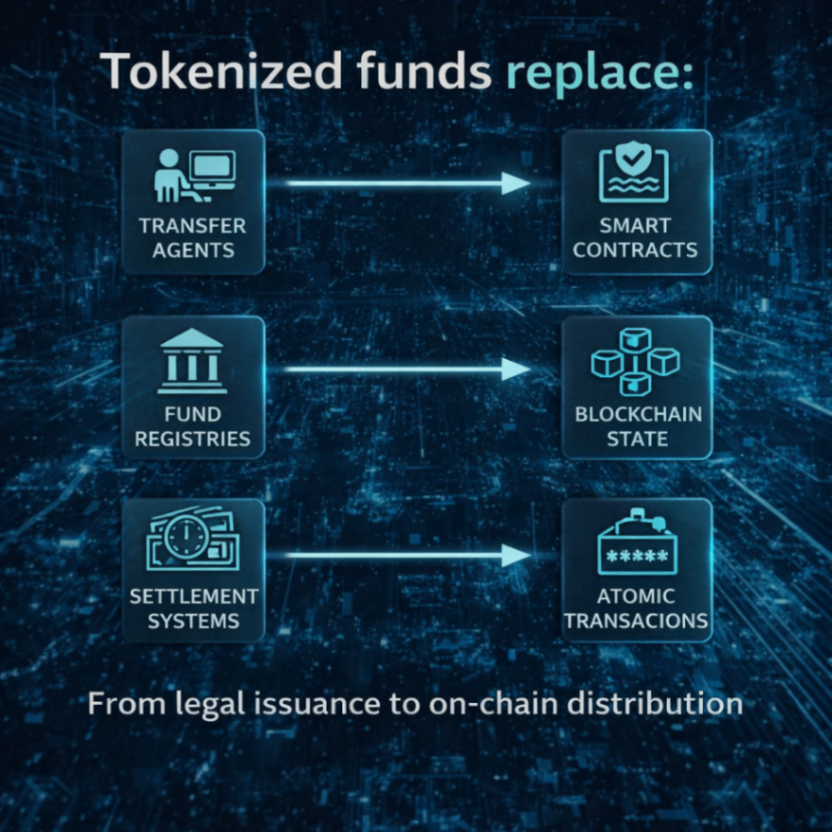
- transfer agents → with smart contracts
- fund registries → with blockchain state
- settlement systems → with atomic transactions
- distribution networks → with programmable access
Instead of stitching together systems, you get: One unified, programmable financial stack
What Tokenized Funds Actually Enable
At a surface level, you get:
- 24/7 trading
- instant settlement
- fractional ownership
But the real shift is deeper:
1. Capital Efficiency Becomes Continuous
Today:
- Capital sits idle during settlement cycles
- Liquidity is trapped in operational processes
With tokenization:
- Settlement is instant
- Capital is always productive
This alone unlocks ~$100B annually in additional investor returns
2. Funds Become Composable Financial Primitives
A tokenized fund is not just an investment.
It becomes:
- collateral
- a building block for derivatives
- a programmable yield instrument
- a component inside other financial products
Funds evolve from products → into infrastructure
3. Distribution Becomes Global and Permissioned
Traditional distribution is:
- jurisdiction-bound
- intermediary-heavy
- slow to scale
Tokenized distribution is:
- wallet-based
- programmable (KYC, restrictions, compliance)
- globally accessible
This unlocks: $290B+ immediate demand from on-chain capital
The Real Opportunity: Connecting Two Worlds
There is a structural gap in markets today:
On one side:
- $2.5T+ in crypto capital
- limited access to real-world yield
On the other:
- $50T+ in traditional funds
- limited access to digital-native investors
Tokenized funds bridge this gap. Not by replacing either system — but by connecting them through a new layer.
Why Most Platforms Will Fail
Tokenization is not about minting tokens.
It requires solving four hard problems simultaneously:
1. Legal wrapper
Funds still need compliant structures (SPVs, funds, jurisdictions)
2. On-chain issuance
Smart contracts, token standards, lifecycle management
3. Compliance
KYC, AML, transfer restrictions, jurisdiction controls
4. Distribution + liquidity
Secondary markets, integrations, investor access
Most solutions solve one piece. The market requires all four.
The Full-Stack Approach
This is where your positioning becomes critical. A real tokenized fund platform must provide:
Issuance Layer
- Fund creation and structuring
- On-chain share representation
- Lifecycle automation
Compliance Layer
- Embedded KYC / AML
- Transfer restrictions
- Jurisdiction-aware logic
Tokenization Engine
- Smart contract infrastructure
- Asset abstraction layer
- Interoperability across chains
Distribution Layer
- Investor access
- Secondary transfers
- API-driven integrations
Wallet & Custody
- Institutional-grade asset control
- Hybrid custody (on/off-chain compatibility)
Why This Matters Now
The timing is not accidental. Three forces are converging:
1. On-chain money is real
- Stablecoins
- Tokenized deposits
- CBDCs
2. Institutions are already moving
- BlackRock
- Franklin Templeton
- UBS
3. Infrastructure is finally usable
- scalable blockchains
- compliant frameworks
- production-grade tooling
We are entering the 12–18 month inflection point
What Winning Looks Like
This market will not be won by “features”. It will be won by:
- controlling issuance infrastructure
- owning distribution rails
- embedding compliance into the protocol
The same way:
- ETFs reshaped asset management
- APIs reshaped fintech
- cloud reshaped software
Tokenization will reshape capital markets
The Bottom Line
Tokenized funds are not a trend. They are the default future of asset management.
- Funds will be issued on-chain
- Money will be programmable
- Distribution will be global
- Liquidity will be continuous
The only question is: Who builds the infrastructure layer?
Global Torque is the full-stack infrastructure for tokenized funds - from legal issuance to on-chain distribution.
We don’t tokenize assets. We build the rails that asset managers run on.